
Imagine a village where the air hums with the rhythmic thud of wooden blocks, where fields of fabric dry under the fierce Rajasthani sun, and where every lane tells a story of generations dedicated to art. This isn’t a scene from a forgotten era; this is Bagru Village, a living, breathing textile museum located just 30 kilometers from the bustling city of Jaipur.
For centuries, Bagru has been home to the Chhipa community, master block printers whose hands have kept alive an ancient craft. A walk through Bagru is more than just a sightseeing tour; it’s an immersive journey into the heart of India’s slow fashion movement. It’s an opportunity to witness raw, unfiltered artistry, smell the earthy aroma of natural dyes, and hear the stories of the families who guard this precious heritage.
Join us on a virtual photo essay and guide as we wander through the printers’ streets of Bagru.
1. The Gateway to Craft: Approaching the Village
As you leave the highway and turn onto the narrower roads leading to Bagru, the landscape slowly begins to change. The typical Rajasthani rural scene of arid fields and small homesteads gives way to glimpses of colorful fabrics draped over walls and drying on rooftops. The first signs of the Chhipa community’s presence are often the large, open fields known as Khet where miles of freshly washed or dyed fabric are spread out to dry.
- Tip for Visitors: It’s best to visit Bagru in the morning, before the heat of the day becomes too intense, and when the workshops are in full swing. Local guides are often available and can help you navigate the workshops.
2. The Thump of Tradition: Entering a Printing Workshop
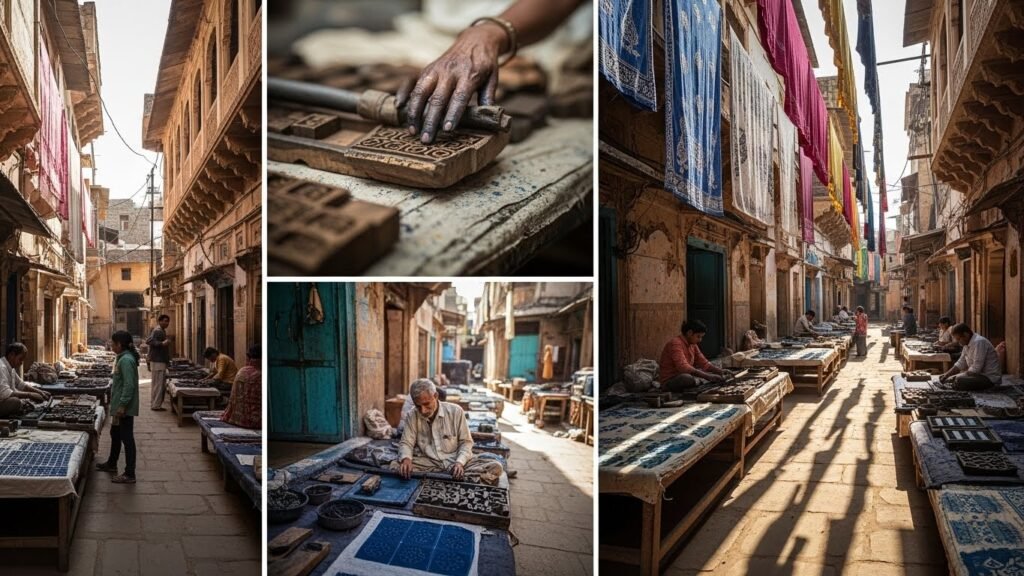
The heart of Bagru lies within its printing workshops, often simple, open-air structures attached to family homes. The moment you step inside, your senses are enveloped.
- The Sound: The defining sound is the incessant, rhythmic “thwack-thwack” of wooden blocks being pressed onto fabric. This is the pulse of Bagru, a meditative beat that speaks of focused concentration and practiced skill.
- The Sight: Long wooden tables stretch across the room, covered with layers of jute and fabric. Artisans, often barefoot, move with incredible precision, dipping their Buntas (blocks) into dye trays and stamping the intricate patterns. The floor is often spattered with dye, a testament to countless hours of work.
- The Smell: A mix of earthy tannins from Harda, the pungent ferment of Syahi (iron black), and the fresh scent of cotton fills the air. It’s an organic aroma, far removed from the sharp chemicals of industrial textile units.
Here, you’ll see printers expertly handling multiple blocks for a single design—first the Rekh (outline), then the Datta (filler), and sometimes the Gadh (background). The coordination required for perfect alignment is astonishing.
3. The Colors of the Earth: The Dyeing Units
Away from the printing tables, you’ll find the dyeing units, often a cluster of vats. This is where the magic of natural colors truly unfolds.
- Indigo Vats: These deep, often sunken, vats hold the precious indigo dye. The color of the liquid might appear green at first, but it turns blue as the fabric is exposed to air, undergoing an oxidation process. You might see bundles of fabric slowly being lowered into these vats, then pulled out, dripping with a mesmerizing shade of green that quickly transforms into the iconic Bagru blue.
- Boiling Vats: Other vats might be simmering with other natural dyes, extracting rich reds from madder root or yellow from turmeric. The air here is often steamy and fragrant with these organic compounds.
- Dabu Paste: Near these areas, you might also spot the distinctive Dabu paste—a thick mud-resist made from clay, wheat flour, and gum. Artisans carefully apply this paste to block out areas of the fabric before dyeing, creating the unique white patterns that are a hallmark of many Bagru prints.
4. The Sun’s Canvas: The Drying Fields (Khet)
No visit to Bagru is complete without witnessing the spectacle of the Khet. These open fields surrounding the Chhipa Mohalla (printers’ quarter) are transformed into a vibrant tapestry.
- Miles of Fabric: Hundreds of meters of fabric—sarees, dupattas, yardage—are spread out flat on the ground, weighted down by stones. This is not merely drying; it’s an integral part of the dyeing process. The sun’s heat and UV rays are crucial for oxidizing the dyes, fixing the colors, and developing their full richness.
- A Photographer’s Dream: The sight of bold patterns and vivid colors against the dry Rajasthani earth is breathtaking. It’s a true photo opportunity, capturing the scale and labor involved in each piece.
- Communal Space: These fields are also communal spaces where villagers gather, exchange news, and oversee the drying process.
5. The Wood Carver’s Studio: Crafting the Buntas
While the printers are the most visible artisans, the foundation of their art lies with the wood carvers. Look for smaller, quieter workshops where the precise, patient work of carving the wooden blocks takes place.
- Master Carvers: These are often individuals from the Gaihar community, whose families have specialized in this intricate craft for generations.
- Tools of the Trade: You’ll see tiny, sharp chisels (Pahari) and mallets, used to carve intricate designs from dense Sheesham or Teak wood. A single block can take days to carve, especially the fine-lined Rekh blocks.
- The Smell of Wood: The air in these studios is filled with the clean, woody scent of sawdust, a stark contrast to the dyes.
6. The Heart of the Community: Life in Chhipa Mohalla
Beyond the workshops and fields, Bagru is a vibrant village where families live and work side-by-side.
- Family Enterprises: Bagru printing is often a family affair. While men are typically seen doing the heavy printing and dyeing, women are involved in fabric preparation, paste mixing, and finishing. Children grow up watching and learning, absorbing the craft through osmosis.
- Simple Living: Life here is rooted in tradition, with a slower pace than the city. Despite the hard work, there’s a strong sense of community and pride in their heritage.
- Small Shops: You might find small, informal shops selling the finished products directly from the printers’ homes. This is often the best place to buy authentic Bagru sarees, supporting the artisans directly.
Conclusion: A Living Legacy
A walk through Bagru Village is more than just observing a craft; it’s experiencing a way of life that celebrates human skill over machine efficiency. It’s a journey that connects you directly to the hands that create your garments, the earth that provides the colors, and the traditions that have endured for centuries.
In an increasingly globalized world, Bagru stands as a powerful reminder that true beauty often lies in imperfection, in the subtle variations of a hand-printed motif, and in the enduring spirit of a community dedicated to its art. So, when you wear a Bagru saree, remember the rhythmic thud, the sun-drenched fields, and the skilled hands that made it—you’re wearing a piece of Rajasthan’s soul.