
In an era of fast fashion and mass production, the allure of the Bagru Saree lies in its connection to the earth. For the conscious consumer, a Bagru print isn’t just a pattern; it’s a biological map of Rajasthan’s flora and minerals. However, as the popularity of these hand-blocked gems has grown, so has the market for “Bagru-style” imitations—synthetic, screen-printed fabrics that mimic the look but lack the soul (and sustainability) of the original.
Distinguishing between genuine vegetable dyes and synthetic “procion” dyes is an essential skill for any textile enthusiast. Authentic Bagru printing is a labor-intensive process involving fermented iron, indigo, and madder root.2 Synthetic versions, meanwhile, use petroleum-based chemicals that are faster to produce but lack the depth and health benefits of natural pigments.
Here is your definitive guide to identifying genuine Bagru vegetable dyes at a glance, ensuring your next purchase supports authentic Chhipa artisans.
1. The “Scent” of the Earth
One of the most immediate ways to identify a genuine Bagru saree is through your sense of smell.
- The Genuine Mark: Natural dyes involve organic fermentation.3 A new Bagru saree often carries a faint, earthy, or even slightly “metallic” scent. This comes from the Syahi (iron fermented with jaggery) and the Harda (myrobalan fruit) used to treat the cloth. If it’s an Indigo saree, it may have a distinct leafy, fermented smell.
- The Synthetic Sign: Synthetic prints are processed with chemical fixatives and detergents. They will either smell like nothing at all or have a sharp, acrid “new clothes” chemical odor.
2. Inspect the Color Palette
The Chhipa community works with a specific “earth-bound” palette. Because they rely on plants and minerals, the colors are limited by nature.
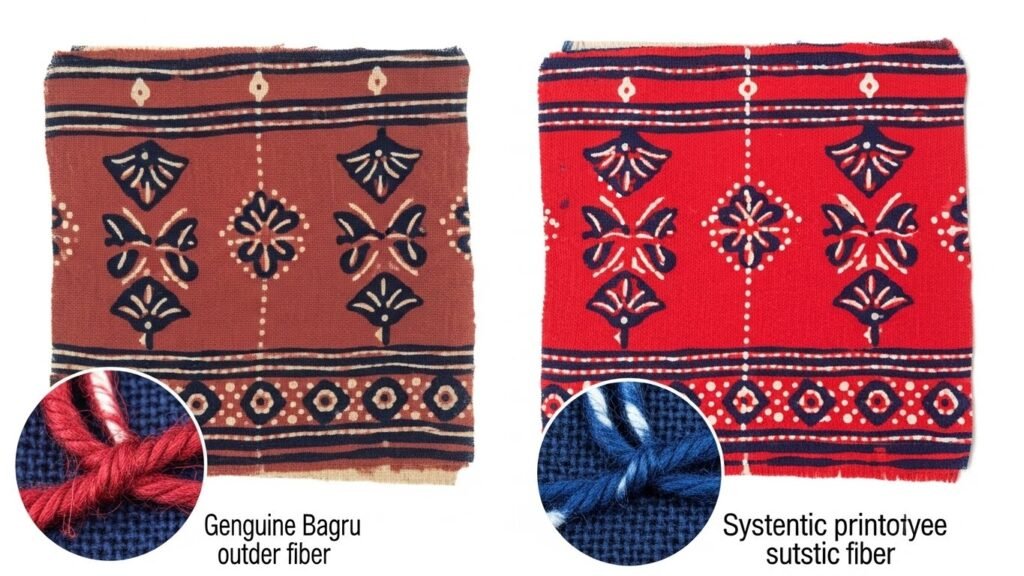
- Natural Colors: Look for “muted” or “deep” tones. Genuine Bagru prints feature Indigo (deep blue), Madder Red (terracotta/maroon), Syahi (black/dark grey), and Harda (pale yellow/cream). These colors have a certain “matte” finish and a visual depth that seems to sink into the fabric.
- Synthetic Colors: If you see neon pinks, electric blues, bright lime greens, or stark “true” whites, it is almost certainly synthetic. Natural vegetable dyes cannot produce “fluorescent” or extremely bright “candy” colors.
3. The “Bleed” and Penetration
Because hand-block printing involves pressing a dye-soaked wooden block onto fabric, the behavior of the ink is a major giveaway.4
- Check the Reverse Side: Turn the saree over. In genuine Bagru printing, the natural dyes (which are liquid and thin) tend to seep through the fibers. You should see a ghost-like version of the print on the back.
- Screen Print Comparison: Synthetic screen prints sit on top of the fabric like a layer of plastic or paint. The reverse side of a synthetic print is usually much paler or almost white, as the thick chemical paste does not penetrate the fibers deeply.
4. The “Harda” Tint
Before a Bagru saree is printed, it is soaked in Harda (myrobalan).5 This is a crucial step that acts as a mordant.
- The Creamy Base: An authentic Bagru saree will rarely have a “paper-white” background. Instead, the unprinted areas will have a slight yellowish, cream, or off-white tint. This is the natural stain of the Harda fruit.
- The Bleached Look: Synthetic fabrics are often chemically bleached to a stark, brilliant white before being printed. If the white parts of the saree look like a sheet of printer paper, it’s likely a factory-made synthetic version.
5. Look for the “Beautiful Flaws”
Perfection is the enemy of authenticity in the world of hand-block printing.
- Joint Marks: Every Bagru saree is printed in segments. If you look closely at the length of the saree, you will occasionally see a “joint mark”—a place where the block was slightly overlapped or where there is a tiny gap in the pattern.
- Color Variations: In a single saree, one floral motif might be slightly darker than the one next to it. This happens because the artisan applies different pressure with their hand, or the dye in the tray was slightly more concentrated at that moment.
- Synthetic Uniformity: Machine or screen prints are mathematically perfect. Every “Buti” (motif) will be exactly the same distance apart, with identical color saturation across 6 yards. If it looks too perfect, it wasn’t made by a human hand.
6. The Water Test (The Rub)
Natural dyes, especially Indigo, are “living” colors. They react to moisture and friction.
- The Dry Rub: Take a small, inconspicuous corner of the saree and rub it against a white piece of cotton or your thumb. A tiny bit of color transfer (especially with Indigo) is a sign of natural dyeing. This is called “crocking.”
- Synthetic Stability: Synthetic dyes are chemically bonded to be “rub-fast” immediately. While this sounds like a benefit, it’s a sign that the fabric has been treated with heavy chemical fixatives.
7. Price Point: The Reality Check
Authentic Bagru printing takes weeks. From washing the fabric in the river to hand-carving blocks and the multiple stages of dyeing and drying, the labor cost is high.
- Authentic Pricing: A genuine hand-block printed Bagru saree using vegetable dyes will usually start from a higher price point (typically ₹2,500 and up, depending on the fabric like Silk or Chanderi).
- Mass Production Pricing: If you find a “Bagru Print” saree for ₹500–₹800 on a discount site, it is 100% a synthetic screen print. You cannot produce a genuine vegetable-dyed piece at that cost.
Summary Comparison Table
| Feature | Genuine Bagru (Natural) | Synthetic / Screen Print |
| Scent | Earthy, metallic, or leafy | Chemical or odorless |
| Colors | Muted reds, indigos, mustard, black | Bright pinks, neons, stark white |
| Reverse Side | Print seeps through significantly | Reverse is very pale or white |
| Texture | Softens over time, “matte” feel | Can feel “plastic-y” or stiff initially |
| Accuracy | Minor overlaps and human “errors” | Mathematically perfect repetition |
| Dyes Used | Plants, minerals, fermented iron | Petroleum-based chemicals |
Why It Matters
Choosing genuine vegetable dyes isn’t just about aesthetics; it’s about health and heritage. Natural dyes are hypoallergenic and kinder to the skin.6 Environmentally, the runoff from natural dye vats in Bagru is biodegradable, whereas synthetic dye waste is a leading cause of water pollution globally.
By learning to spot the difference, you protect the legacy of the Chhipa community and ensure that this 400-year-old art form remains viable in a world of clones.