
In the world of Bagru textiles, the saree is the final masterpiece, but the Bunta (wooden block) is the unsung hero. Before a single drop of Indigo touches the fabric, and long before the artisan’s hand begins its rhythmic thumping, a master carver must spend days hunched over a small piece of wood, transforming a solid block into a delicate stamp.
The “Anatomy of a Block” is a fascinating journey into the heart of Indian woodworking. These hand-carved instruments are the DNA of the Bagru tradition. To understand the block is to understand the soul of the print. Let’s dive into the intricate process of how these wooden wonders are brought to life.
1. Choosing the Skeleton: The Wood Matter
Not all wood is created equal when it comes to block printing. A block must be heavy enough to hold a steady print, porous enough to “grip” the dye, but strong enough to withstand thousands of high-pressure strikes against a table.
- Sheesham (Indian Rosewood): This is the gold standard for Bagru blocks. Sheesham is incredibly durable and resistant to warping when exposed to the moisture of water-based natural dyes.
- Teak (Sagwan): Occasionally used for larger, less intricate patterns, teak offers great longevity and natural oils that protect the wood from the harsh elements of the dye vat.
- Seasoning: Before carving begins, the wood must be seasoned. It is soaked in oil for several days to prevent it from cracking during the carving process or expanding when it eventually meets the liquid dyes.
2. The Blueprint: Drawing the “Naksha”
Carving begins with a flat, sanded surface. The master carver (often from the Gaihar community, specialized in woodcraft) applies a thin layer of white lime paste to the surface of the wood. This creates a “canvas” where the design will be visible.
Using a pencil or a fine needle, the carver traces the Naksha (the design). Whether it is a traditional Booti (small floral sprig), a Jaal (intricate mesh), or a Bel (creeper vine), every line must be mathematically precise. In Bagru printing, symmetry is key because the blocks must “join” seamlessly across six yards of fabric without showing a break in the pattern.
3. The Three Types of Blocks
To create a single multicolored Bagru saree, an artisan doesn’t just use one block. They use a family of blocks that work in perfect harmony:
- Rekh (The Outline): This is the most difficult block to carve. It provides the “skeleton” of the design. The lines are razor-thin, often no thicker than a needle’s edge.
- Datta (The Filler): These blocks are used to fill in the colors within the outlines. If the Rekh is the coloring book, the Datta is the crayon.
- Gadh (The Background): This is a “negative” block used to print the background color while leaving the motifs blank. These are usually the heaviest and largest blocks.
4. The Carving Process: Precision and Patience
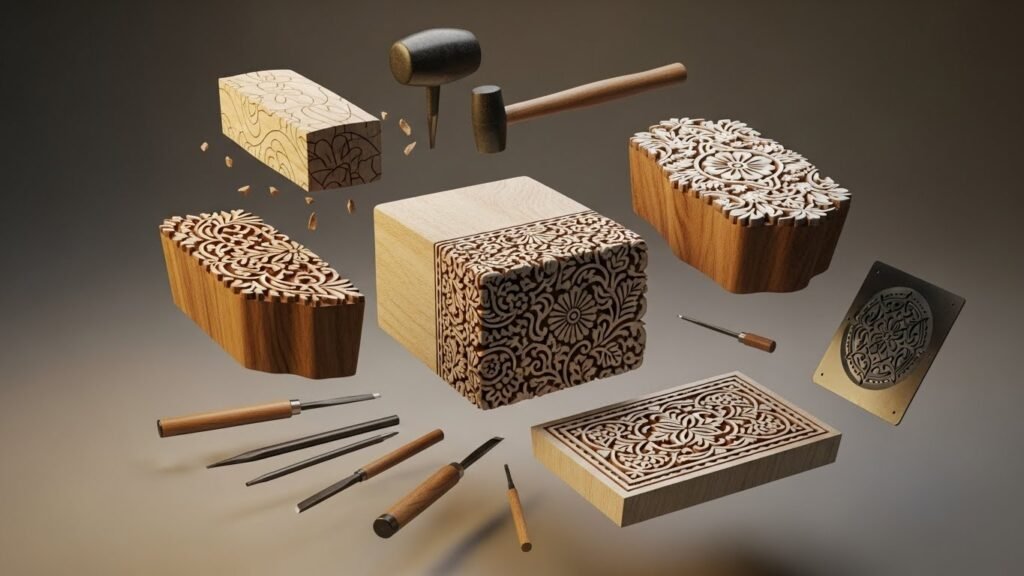
Carving is a subtractive art. The carver uses a set of small, hand-forged steel chisels called Pahari.
With a small wooden mallet, the carver taps away the “white space” of the design. They must carve deep enough (usually about 1 to 2 centimeters) so that the dye doesn’t smudge into the background when pressed onto the fabric.
One of the most ingenious parts of a Bunta’s anatomy is the Air Holes. If you look closely at a large wooden block, you’ll see tiny holes drilled through the back. These allow air to escape when the block is pressed into the dye-soaked tray, preventing air bubbles from ruining the print and ensuring an even distribution of color.
5. The Handle and Alignment: Pitch Pins
The back of the block features a sturdy handle, hand-carved from the same piece of wood. It is shaped to fit perfectly in the palm of a printer’s hand, allowing them to exert maximum pressure with a single strike.
Look for the Pitch Pins. These are tiny metal or wooden pins placed on the corners of the block. They act as “navigation points.” When the printer moves from one strike to the next, they align these pins with the previous print to ensure the pattern remains perfectly straight and the “joins” are invisible to the naked eye.
6. Curing the Block
Once the carving is complete, the block isn’t ready for the table immediately. It must be “cured.”
The block is submerged in mustard oil or linseed oil for at least 10 to 15 days. This deep-conditioning makes the wood supple and prevents it from absorbing too much water from the dyes, which would cause the wood to swell and the fine lines of the Rekh to blur.
7. The Lifecycle of a Bunta
A well-made Sheesham block can last for decades. In many Bagru workshops, you will find blocks that have been used by three generations of printers. Over time, the edges of the wood soften, and the block develops a “memory” of the dye it has held.
However, as the wood eventually wears down, the lines become less crisp. At this point, the block is retired, often finding a second life as a piece of heritage decor, or it is carefully sanded down and re-carved with a new design.
Conclusion: The Human Touch in Every Stamp
The next time you hold a Bagru saree, take a moment to look at the tiny details of the print. Think about the carver who sat for hours, chiseling away the hardwood to create that specific floral petal.
In an age of digital printing and lasers, the hand-carved Bunta remains a testament to human skill. It is an instrument of precision that doesn’t require electricity—only a sharp eye, a steady hand, and a deep respect for the wood.