
If you were to walk through the sun-drenched streets of Bagru, Rajasthan, you would see vast stretches of fabric laid out to dry, shimmering with a distinct, pale yellow hue. This yellowish tint is not a design choice, nor is it a sign of aging. It is the mark of Harda, an unassuming dried fruit that serves as the literal backbone of the entire Bagru printing tradition.
In the world of synthetic textiles, we often take color for granted. We expect dyes to “stick” to fabric instantly. But in the realm of natural dyeing, plants and minerals don’t always want to bond with cotton. They need a mediator—a chemical bridge. In Bagru, that bridge is the Myrobalan fruit, known locally as Harda. Without it, the vibrant Indigos would wash away, and the deep iron blacks would never take hold.
Let’s explore the “Magic of Harda” and why this small, shriveled fruit is the most important secret ingredient in your Bagru saree.
1. What is Harda? (The Botanical Profile)
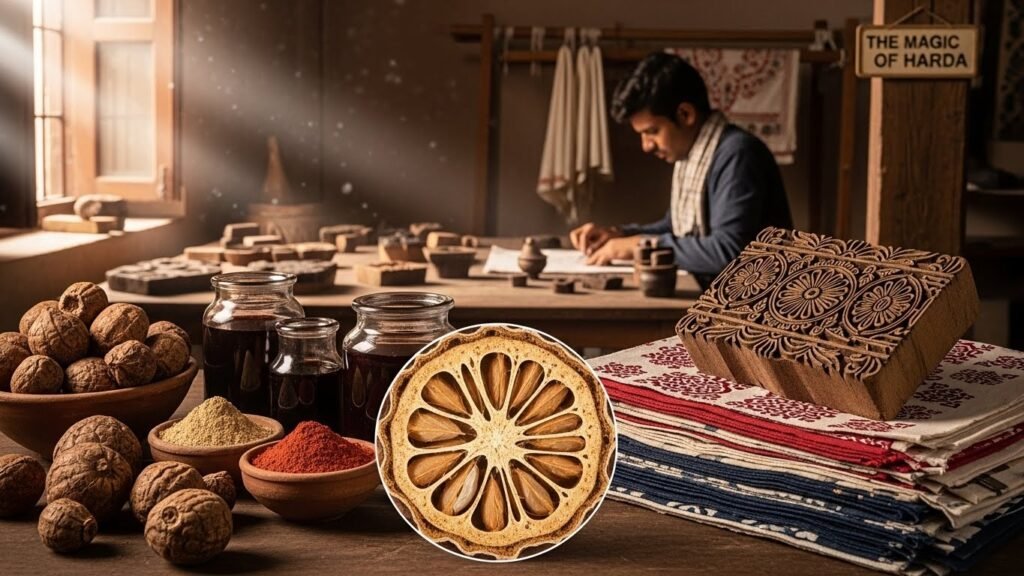
Harda is the fruit of the Terminalia chebula tree, commonly known as Black Myrobalan. While it is famous in Ayurvedic medicine for its digestive and healing properties, the Chhipa community of Rajasthan has used it for centuries as a mordant.
In textile terms, a mordant is a substance that fixes a dye to a fabric by forming a coordination complex with the dye. Harda is exceptionally rich in tannins. These tannins act as the “glue” that allows natural pigments to penetrate the cellulose fibers of the cotton and stay there permanently.
2. The Yellow Transformation: The Pre-Treatment Process
The journey of a Bagru saree begins not with a block, but with a bath. Before any printing occurs, the raw fabric (usually “Kora” cotton) must be prepared. This process is known as Harda Rangai.
- The Solution: Dried Harda fruits are ground into a fine powder and mixed with water in large copper vats.
- The Soaking: The fabric is submerged in this yellowish-brown liquid, ensuring every fiber is saturated with tannins.
- The Sun’s Role: After soaking, the fabric is spread out under the intense Rajasthani sun. As the water evaporates, the tannins bind to the cotton, leaving the fabric with a characteristic creamy-yellow tint.
This yellowish base is the canvas of a Bagru print. If you see a “Bagru-style” saree that has a stark, bleached-white background, it is a sign that it skipped the Harda process—meaning it likely uses synthetic dyes rather than traditional vegetable ones.
3. The Chemistry of Color: How Harda Reacts
The true “magic” of Harda happens when the printing blocks hit the fabric. Harda doesn’t just hold the dye; it changes the color through chemical reactions.
The Birth of Black (Syahi)
The most iconic reaction in Bagru printing is between Harda and Syahi. Syahi is a natural ink made from fermented iron filings and jaggery. When the iron-rich ink touches the tannin-rich Harda fabric, a chemical reaction occurs that turns the ink into a deep, permanent, jet black. This is essentially the same chemistry used to make traditional iron-gall ink used by medieval scribes!
The Depth of Red (Begar)
When printing with red dyes (Alizarin), the Harda acts as a stabilizer. It ensures that the red remains earthy and deep rather than turning into a bright, translucent pink.
4. Why Harda is the “Health” Secret of Bagru
One of the most overlooked benefits of the Harda process is its impact on the wearer. Because Harda is a potent Ayurvedic herb, traditional Bagru sarees were often considered “Ayurvastra” (clothing for health).
- Anti-Bacterial Properties: Harda is naturally antimicrobial. Wearing a fabric treated with Myrobalan was traditionally believed to protect the skin from infections and rashes, especially in the humid Indian climate.
- Skin Friendly: Unlike synthetic mordants (like heavy metal chrome), Harda is completely non-toxic and biodegradable. It is so safe that the same fruit is used in herbal teas and health supplements.
5. Environmental Sustainability: The “Green” Mordant
In modern industrial textile dyeing, the water runoff is often toxic due to heavy metal mordants. In Bagru, the Harda process is a closed-loop gift from nature.
The water used for the Harda bath is organic. When it drains into the soil, it doesn’t poison the groundwater; it acts as a natural mulch. This “Slow Fashion” approach ensures that the art of Bagru printing gives back to the earth more than it takes.
6. How to Identify the Harda Touch
For a buyer, recognizing the presence of Harda is the easiest way to verify authenticity.
- Look for the Cream: A genuine Bagru saree will have an off-white, cream, or pale yellow base. This is the natural color of the Harda-treated cotton.
- The Faint Scent: If you smell a fresh Bagru saree, it has a slightly nutty, medicinal, or woody aroma. That is the scent of the Myrobalan fruit still lingering in the fibers.
- Softness: Harda helps in softening the cotton fibers. After the first wash (where the excess Harda is rinsed away), the fabric becomes incredibly soft to the touch, making it perfect for summer wear.
Conclusion: Respecting the Fruit
We often credit the artisans and the block carvers for the beauty of a Bagru saree—and rightly so. But we must also pay homage to the Terminalia chebula tree and its humble fruit. Without the Magic of Harda, the colors of Rajasthan would have no place to rest.